Back to Name List
Now you are viewing:
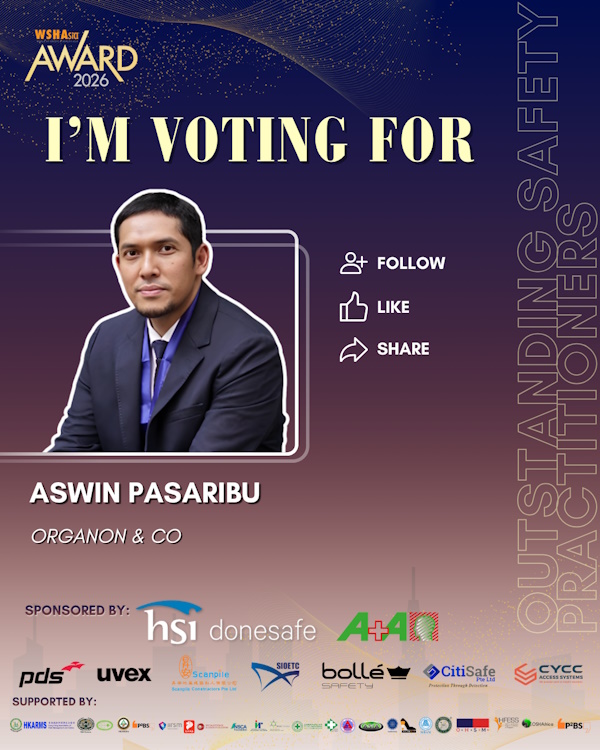
Name: Aswin Pasaribu
Country: Indonesia
Country: Indonesia
About Aswin Pasaribu
Aswin Pasaribu is an HSE leader based in Indonesia with more than 19 years of experience in multinational manufacturing and the pharmaceutical industry. He currently serves as Associate Director EHS, leading occupational safety, industrial hygiene, and environmental sustainability for a 300-person site. His work focuses on ISO 45001 and ISO 14001 system maturity, high-risk work control, contractor governance, and digital transformation through e Permit to Work. He is known for practical execution, strong stakeholder influence, and measurable risk reduction through disciplined assurance, coaching, and data-led decision making.
List the Safety and Health achievements/contributions you have achieved in 2025.
In 2025, he delivered strong safety performance and strengthened management system reliability by focusing on critical risk control and governance discipline. Their site achieved LTIR 0 and RIR 0 for the year, supported by consistent field verification and effective corrective action management. They achieved 100% on-time closure for ISO audit findings, with internal audits and global corporate audits completed on schedule. Permit-to-Work compliance reached 99%, improving high-risk work control and contractor discipline. They also increased proactive reporting through hazard reports and safety comment forms, strengthening early risk identification and learning. These results were reinforced by external recognition through a Zero Accident Award from the Governor of East Java, received in February 2026 based on 2025 performance and verification.
Outline the Workplace Safety and Health initiatives that have been implemented by you in your workplace in 2025.
In 2025, he implemented a set of integrated initiatives to strengthen critical controls and operational ownership. Key programs included the rollout of e-Permit-to-Work, a contractor management strengthening programme, a machine safety improvement programme, and a more structured industrial hygiene programme. These initiatives were supported by stronger risk assessment quality for non-routine work, improved verification routines for high-risk activities, and clearer action tracking to ensure timely closure. He also reinforced system discipline through structured internal audits, corporate audit readiness routines, and management review governance to embed improvements into daily operations. The focus was to move from paper compliance to reliable, verified controls that protect people and support stable production.
Describe and support in detail on how your influencing capability has assisted in the successful implementation of these initiatives.
His influencing approach is grounded in credibility, practicality, and an understanding of people. When some leaders resisted formal Permit-to-Work for maintenance due to perceived operational delays, he responded with evidence, not opinion. He analysed near miss data from the past two years and presented the risk exposure, including potential downtime and legal risk. He then proposed a one-month pilot using a simplified workflow to demonstrate effectiveness without adding unnecessary bureaucracy. The outcome was permanent implementation of Permit-to-Work. Within six months, unsafe interventions reduced by 40%, there were no LTIs linked to maintenance or non-routine work, and external audit results improved from minor findings to zero major findings. He also use tailored 1:1 communication to meet stakeholders where they are, including informal settings, to secure alignment and sustained commitment.
Describe and provide support on how your initiative impacted the Safety and Health management and performance of your workplace/community/industry that was above and beyond.
The initiatives delivered impact beyond compliance by strengthening both system maturity and real operational control. e-Permit-to-Work and stronger contractor governance improved planning quality, control verification, and accountability for non-routine work. High compliance and disciplined closure reduced repeat issues and increased audit confidence, while increased hazard reporting improved early detection and learning. The measurable reduction in unsafe interventions demonstrated that controls were being applied in practice, not only documented. These outcomes supported sustained zero incident performance and strengthened organisational reliability. Beyond the workplace, the approach created a more proactive safety culture where leaders and teams use data, field verification, and coaching to continuously improve. Recognition through the East Java Governor Zero Accident Award reinforced that the performance was credible and independently validated.
In your opinion, what are the attributes of a safety influencer? Do share with us on how you have demonstrated these attributes in your daily work that will earn you the recognition of a WSHAsia Safety Influencer Award Winner in your workplace/community/industry.
A safety influencer combines technical credibility with trust and the ability to mobilise consistent action. Core attributes include clear communication, courage to challenge unsafe norms, empathy with firm standards, practical problem solving, and persistence in follow through. He demonstrates these by staying close to operations, focusing on critical risks, and coaching supervisors, engineering teams, and contractors to strengthen control reliability. He tailors communication to different stakeholders to ensure the message is understood and acted upon, and he builds coalitions across functions to remove barriers. He also uses data and field verification to keep improvements honest and measurable. This approach builds ownership and makes safe performance a stable operational standard, not a temporary campaign.
No. of Years of Experience in a Safety Role:
20 Years