Back to Name List
Now you are viewing:
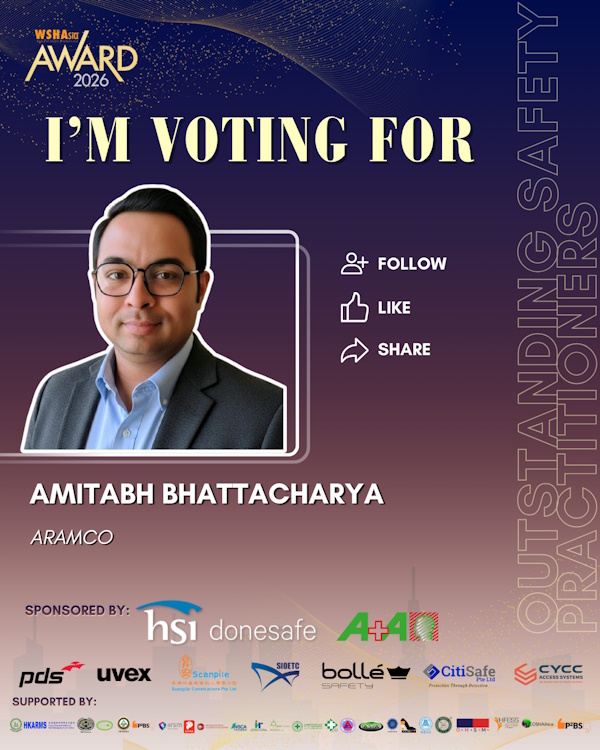
Name: Amitabh Bhattacharya
Country: India
Country: India
About Amitabh Bhattacharya
Amitabh Bhattacharya is an Enterprise HSE Leader with over 15 years of experience across the Middle East and India, driving safety governance in oil and gas, construction, and energy sectors. He has led transformative HSE strategies for organisations including Saudi Aramco, Cairn Oil & Gas, Halliburton, and Baker Hughes, delivering measurable reductions in incidents and strengthening board level risk oversight. Known for turning compliance driven systems into performance focused cultures, he aligns safety with business outcomes, protects assets, and builds leadership accountability at scale.
List the Safety and Health achievements/contributions you have achieved in 2025.
In 2025, he strengthened enterprise HSE governance while serving in a senior role with Saudi Aramco, acting as the central authority between owner leadership and EPC contractors. He achieved zero major non conformities across internal, client and regulatory audits by enforcing disciplined contractor oversight and compliance tracking. Procedural and statutory compliance improved by 27% through structured inspections and closure governance. He increased workforce engagement in behavioral safety programs by 35% and reduced emergency response time by 20% through focused drills and PTW oversight. He consolidated multi source HSE data into executive dashboards, enabling leadership to make risk informed decisions at quarterly reviews. Beyond operational delivery, he continued strategic advisory engagements across high risk sectors, strengthening leadership accountability and sustaining zero major incident performance across multiple locations.
Outline the Workplace Safety and Health initiatives that have been implemented by you in your workplace in 2025.
In 2025, while serving in an enterprise HSE role with Saudi Aramco, he implemented structured governance initiatives to strengthen workplace safety and health performance. He standardised contractor HSE oversight through enhanced prequalification reviews, inspection regimes, and corrective action closure tracking, resulting in measurable compliance improvement. A risk based PTW assurance program was reinforced to close execution gaps in high risk activities. Behavioural safety campaigns were relaunched with clear leadership visibility, increasing workforce participation and proactive hazard reporting. He introduced consolidated executive dashboards integrating multi source HSE data, enabling leadership to review risk exposure, audit status, and leading indicators in real time. Emergency preparedness was strengthened through scenario based drills that reduced response time and clarified command accountability. These initiatives shifted the focus from reactive compliance to disciplined, performance driven safety management aligned with enterprise risk priorities.
Describe and support in detail on how your influencing capability has assisted in the successful implementation of these initiatives.
Successful implementation depended less on authority and more on influence. In 2025, within his governance role at Saudi Aramco, he was not the line manager of most contractor teams, yet performance improved because he positioned safety as a risk and business continuity issue, not a compliance checklist. he translated audit findings and PTW gaps into potential cost exposure, production loss, and reputational impact, which secured senior leadership backing. With contractors, he avoided policing language and focused on shared risk ownership, using data from inspections and dashboards to make performance visible and difficult to ignore. During behavioural safety relaunches and emergency drills, he ensured leaders were physically present, reinforcing accountability through visibility rather than memos. Resistance was addressed through one-to-one engagement with project managers, clarifying expectations and consequences. By aligning safety objectives with operational targets and executive reviews, the initiatives moved from optional programmes to performance commitments.
Describe and provide support on how your initiative impacted the Safety and Health management and performance of your workplace/community/industry that was above and beyond.
In 2025, his initiatives went beyond routine compliance and created structural shifts in safety management within his role at Saudi Aramco. By consolidating fragmented HSE data into executive dashboards, he moved safety discussions from lagging injury metrics to real time risk exposure and control effectiveness, directly influencing leadership decisions on contractor accountability and resource allocation. Strengthened governance over PTW assurance, inspections, and corrective action tracking improved statutory compliance by 27% and sustained zero major non conformities during audits. Emergency drill restructuring reduced response time by 20%, strengthening operational resilience. Beyond the workplace, these governance and data driven models were shared across advisory engagements in multiple high risk sectors, demonstrating how disciplined oversight and visible leadership can elevate industry standards. The impact was not a campaign, it was a shift in how safety performance is defined, measured, and owned at the leadership level.
In your opinion, what are the attributes of a safety influencer? Do share with us on how you have demonstrated these attributes in your daily work that will earn you the recognition of a WSHAsia Safety Influencer Award Winner in your workplace/community/industry.
A safety influencer earns credibility through competence, consistency, and courage. Technical depth builds trust, but clarity in communication turns data into decisions. Influence requires the ability to challenge leaders respectfully, hold contractors accountable without ego, and stay visible in the field. In his role with Saudi Aramco, he demonstrates this daily by translating risk exposure into business impact, ensuring safety is discussed alongside cost and continuity. He reinforces accountability by making performance transparent through executive dashboards and structured reviews. On site, he engages supervisors and frontline teams directly, encouraging proactive reporting and ownership rather than fear driven compliance. he does not rely on position alone; he relies on preparation, evidence, and steady follow through. These attributes have strengthened governance, improved participation, and sustained zero major non conformities, reflecting influence that shapes culture, not just outcomes.
No. of Years of Experience in a Safety Role:
16 Years