Back to Name List
Now you are viewing:
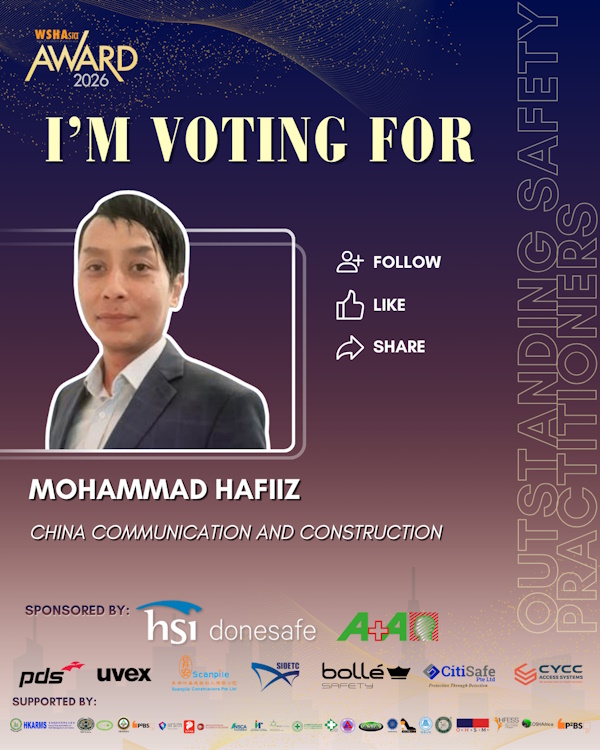
Name: Mohammad Hafiiz
Country: Singapore
Country: Singapore
About Mohammad Hafiiz
Mohammad Hafiiz is a practicing WSH Officer for more than 10 years in Singapore. He specialises in the construction of Singapore’s Mass Rapid Transit (MRT) as a main contractor that builds underground rail station and tunnels. He is currently employed in China Communications Construction Company (CCCC) Ltd and is actively involved as the WSH Manager in the construction of ‘Clementi Interchange Station and Associated Additions & Alterations Works for Cross Island Line’.
List the Safety and Health achievements/contributions you have achieved in 2025.
Mohammad Hafiiz provided leadership in implementing the WSH management system for the mega project, overseeing safety performance for complex underground MRT construction works. Under his leadership, the project successfully achieved the British Safety Council International Safety Award 2025, recognising its strong commitment to health, safety, and wellbeing.
He also commissioned and operationalised the project’s Safety Training Centre, which delivers structured safety induction, competency training, and hazard awareness programmes for the workforce. He strengthened risk management through rigorous implementation and review of Risk Assessments, Safe Work Procedures, and Permit-to-Work systems for high-risk activities such as deep excavation, lifting operations, and underground works.
In addition, he promoted proactive hazard identification and near-miss reporting, led regular safety engagement initiatives including toolbox briefings, safety campaigns, and leadership walkabouts, and enhanced subcontractor safety compliance. He strengthened competency and accountability across the workforce, contributing to the project achieving 1,500,000 safe manhours without a major incident.
He also commissioned and operationalised the project’s Safety Training Centre, which delivers structured safety induction, competency training, and hazard awareness programmes for the workforce. He strengthened risk management through rigorous implementation and review of Risk Assessments, Safe Work Procedures, and Permit-to-Work systems for high-risk activities such as deep excavation, lifting operations, and underground works.
In addition, he promoted proactive hazard identification and near-miss reporting, led regular safety engagement initiatives including toolbox briefings, safety campaigns, and leadership walkabouts, and enhanced subcontractor safety compliance. He strengthened competency and accountability across the workforce, contributing to the project achieving 1,500,000 safe manhours without a major incident.
Outline the Workplace Safety and Health initiatives that have been implemented by you in your workplace in 2025.
Mohammad Hafiiz spearheaded several key Workplace Safety and Health (WSH) initiatives to strengthen safety standards and workforce competency.
A key milestone was the successful commissioning and operations of the project’s Safety Training Centre, which provides structured safety induction, competency development, and hazard awareness training to ensure workers are well-prepared before entering high-risk construction environments.
To enhance training effectiveness, Virtual Reality (VR) safety training modules were introduced to simulate high-risk construction scenarios such as working at height, lifting operations, and confined space work. These immersive simulations allow workers to better visualise hazards and understand safe work practices in a controlled environment.
He also implemented technology-enabled safety solutions for working at height, incorporating improved fall protection systems, engineered anchor points and smart safety hardware to strengthen monitoring and risk control for high-risk activities.
A key milestone was the successful commissioning and operations of the project’s Safety Training Centre, which provides structured safety induction, competency development, and hazard awareness training to ensure workers are well-prepared before entering high-risk construction environments.
To enhance training effectiveness, Virtual Reality (VR) safety training modules were introduced to simulate high-risk construction scenarios such as working at height, lifting operations, and confined space work. These immersive simulations allow workers to better visualise hazards and understand safe work practices in a controlled environment.
He also implemented technology-enabled safety solutions for working at height, incorporating improved fall protection systems, engineered anchor points and smart safety hardware to strengthen monitoring and risk control for high-risk activities.
Describe and support in detail on how your influencing capability has assisted in the successful implementation of these initiatives.
Mohammad Hafiiz influencing capability played a key role in the successful implementation of these WSH initiatives. He worked closely with project management, engineers, supervisors, and subcontractors to build strong alignment on the importance of proactive safety measures and the adoption of new technology.
To secure management support for these initiatives, he presented clear risk assessments, operational benefits, and long-term improvements to workforce competency and incident prevention. This helped gain leadership commitment and the necessary resources for implementation.
At the operational level, he engaged supervisors and workers through regular safety briefings, demonstrations, and training sessions to ensure they understood the practical benefits of these initiatives. By encouraging open communication and addressing concerns on-site, he was able to build trust and promote acceptance of new systems and technologies. Through continuous engagement, collaboration, and strong leadership presence on site, he was able to influence stakeholders across all levels to embrace these initiatives, ultimately strengthening safety awareness, compliance, and safety culture across the project workforce.
To secure management support for these initiatives, he presented clear risk assessments, operational benefits, and long-term improvements to workforce competency and incident prevention. This helped gain leadership commitment and the necessary resources for implementation.
At the operational level, he engaged supervisors and workers through regular safety briefings, demonstrations, and training sessions to ensure they understood the practical benefits of these initiatives. By encouraging open communication and addressing concerns on-site, he was able to build trust and promote acceptance of new systems and technologies. Through continuous engagement, collaboration, and strong leadership presence on site, he was able to influence stakeholders across all levels to embrace these initiatives, ultimately strengthening safety awareness, compliance, and safety culture across the project workforce.
Describe and provide support on how your initiative impacted the Safety and Health management and performance of your workplace/community/industry that was above and beyond.
Mohammad Hafiiz's initiatives significantly strengthened the WSH management and performance by introducing proactive and technology-driven approaches that went beyond conventional safety practices. The establishment of the project’s Safety Training Centre created a structured platform for practical safety learning, ensuring workers were well-prepared before entering high-risk work areas.
The introduction of Virtual Reality (VR) safety training enhanced workforce competency by allowing workers to experience realistic simulations of high-risk scenarios such as working at height. This innovative training approach significantly improved hazard recognition and safe work behaviours.
In addition, the digitalisation of key safety processes tremendously improved efficiency, accountability, and accessibility of safety management practices. Technology-enabled solutions for working at height further strengthened risk control through improved fall protection systems and engineered safety measures.
Collectively, these initiatives elevated safety standards beyond routine compliance and contributed to the project successfully achieving 1,500,000 safe manhours without a major incident.
The introduction of Virtual Reality (VR) safety training enhanced workforce competency by allowing workers to experience realistic simulations of high-risk scenarios such as working at height. This innovative training approach significantly improved hazard recognition and safe work behaviours.
In addition, the digitalisation of key safety processes tremendously improved efficiency, accountability, and accessibility of safety management practices. Technology-enabled solutions for working at height further strengthened risk control through improved fall protection systems and engineered safety measures.
Collectively, these initiatives elevated safety standards beyond routine compliance and contributed to the project successfully achieving 1,500,000 safe manhours without a major incident.
In your opinion, what are the attributes of a safety influencer? Do share with us on how you have demonstrated these attributes in your daily work that will earn you the recognition of a WSHAsia Safety Influencer Award Winner in your workplace/community/industry.
Mohammad Hafiiz believes he has demonstrated key attributes expected of a Safety Influencer Award through innovation, collaboration, and measurable impact on WSH performance.
Firstly, he demonstrated strong safety leadership and influence by championing key safety initiatives and securing support from management, supervisors, and subcontractors for their successful implementation. By clearly communicating the operational benefits and safety value of these initiatives, he was able to align stakeholders across different levels of the project and drive the adoption of improved safety practices.
Secondly, he introduced innovative safety solutions including the establishment of a dedicated Safety Training Centre. These forward-looking initiatives enhanced workforce competency, strengthened risk management, and elevated safety standards beyond traditional compliance.
Thirdly, he actively fostered a proactive safety culture by engaging workers through training programmes, safety briefings, and open communication, encouraging them to take ownership in identifying hazards and maintaining safe work practices.
Firstly, he demonstrated strong safety leadership and influence by championing key safety initiatives and securing support from management, supervisors, and subcontractors for their successful implementation. By clearly communicating the operational benefits and safety value of these initiatives, he was able to align stakeholders across different levels of the project and drive the adoption of improved safety practices.
Secondly, he introduced innovative safety solutions including the establishment of a dedicated Safety Training Centre. These forward-looking initiatives enhanced workforce competency, strengthened risk management, and elevated safety standards beyond traditional compliance.
Thirdly, he actively fostered a proactive safety culture by engaging workers through training programmes, safety briefings, and open communication, encouraging them to take ownership in identifying hazards and maintaining safe work practices.
No. of Years of Experience in a Safety Role:
15 Years