Back to Name List
Now you are viewing:
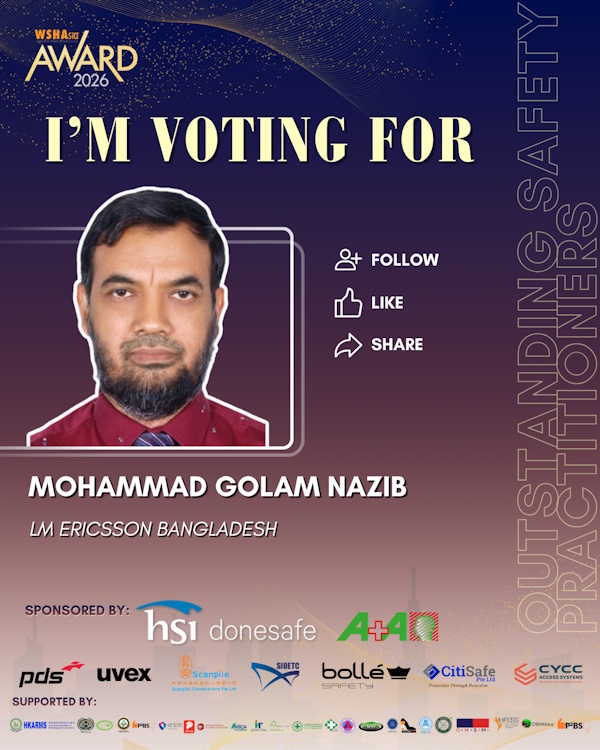
Name: Mohammad Golam Nazib
Country: Bangladesh
Country: Bangladesh
About Mohammad Golam Nazib
Engr. Mohammad Golam Nazib is a seasoned QHSE leader with over 20 years of international experience across oil & gas, power generation, construction, and telecommunications. Currently serving as Country Head of EHS at LM Ericsson Bangladesh and QHSE Expert Trainer with FFS Consultants Bangladesh & TÜV Austria, IISPL, he has led large-scale operations managing up to 10,000 employees and 120 HSE professionals. As a NEBOSH IGC holder and ISO 9001:2015 & ISO 45001: 2018 Lead Auditor, he is passionate about cultivating proactive safety culture, strengthening compliance systems, and developing future safety leaders through training and mentorship.
List the Safety and Health achievements/contributions you have achieved in 2025.
In 2025, he strengthened organisational safety governance by enhancing risk assessment frameworks, contractor safety compliance systems, and CAPA effectiveness within high-risk construction and telecom projects. He led structured HSE audits, improved PTW/LOTO compliance monitoring, and implemented data-driven KPI tracking to reduce incident trends and near-miss recurrence. Through targeted leadership engagement and toolbox programs, he reinforced accountability across project teams and subcontractors. As a certified trainer, he conducted professional QHSE training sessions aligned with ISO 9001 and ISO 45001 principles, equipping managers and supervisors with practical safety leadership skills. His efforts enhanced regulatory compliance, improved reporting transparency, and fostered stronger safety ownership across multi-site operations.
Outline the Workplace Safety and Health initiatives that have been implemented by you in your workplace in 2025.
In 2025, he has implemented structured behavioral reinforcement initiatives integrating Behavioral Based Safety (BBS) principles with Stop Work Authority (SWA) empowerment at site level. He strengthened digital incident tracking and root cause analysis processes to ensure timely corrective and preventive actions. A risk-based inspection model was introduced focusing on high-risk activities such as working at height, lifting operations, excavation, heavy equipment movement, and confined space work. He enhanced contractor onboarding processes by embedding safety competency verification and refresher training modules. Regular leadership walkthroughs and quarterly governance reviews were institutionalised to align operational performance with strategic HSE objectives. These initiatives improved proactive hazard identification, compliance consistency, and workforce engagement across projects.
Describe and support in detail on how your influencing capability has assisted in the successful implementation of these initiatives.
His influencing capability stems from credibility built through hands-on field experience and transparent leadership. By actively engaging project managers, engineers, and frontline supervisors in risk assessments and incident reviews, he transformed safety from a compliance requirement into a shared responsibility. He has conducted focused leadership briefings and practical scenario-based training to shift mindsets from reactive correction to proactive prevention. Through open communication forums, he encouraged reporting of near-misses without blame, strengthening psychological safety. His data-driven presentations to senior management linked safety performance with operational efficiency, gaining strategic buy-in for resource allocation. By modeling ethical leadership and consistently reinforcing SWA culture, he has inspired teams to prioritise safety even under project pressure, ensuring sustained implementation success.
Describe and provide support on how your initiative impacted the Safety and Health management and performance of your workplace/community/industry that was above and beyond.
His initiatives significantly elevated safety maturity beyond basic compliance. By integrating structured KPI analysis with behavioral engagement, he has improved leading indicators such as near-miss reporting, safety observations, and training participation. The strengthened PTW/LOTO compliance system minimised high-risk exposure and improved audit outcomes. Enhanced contractor management reduced safety gaps across subcontracted operations, positively influencing broader industry practices. Through professional training delivery and mentorship, he has contributed to developing competent HSE professionals who now lead safety functions independently. His cross-sector experience from oil & gas, power plants, and telecommunications allowed him to transfer global best practices into local operations, raising overall industry standards. The result was improved regulatory confidence, stronger client trust, and measurable enhancement in workplace safety culture.
In your opinion, what are the attributes of a safety influencer? Do share with us on how you have demonstrated these attributes in your daily work that will earn you the recognition of a WSHAsia Safety Influencer Award Winner in your workplace/community/industry.
A safety influencer demonstrates integrity, technical competence, empathy, courage to intervene, and the ability to inspire behavioral change. He exemplifies these attributes through consistent field presence, evidence-based decision-making, and respectful engagement with workers at all levels. He leads by example—wearing PPE correctly, participating in toolbox talks, and personally reviewing high-risk permits. His technical background in mechanical engineering and international QHSE exposure strengthens his credibility, while his training expertise enhances communication effectiveness. He promotes accountability without blame and empowers employees through 'Stop Work Authority' culture. By combining strategic thinking with operational discipline, he transforms safety from policy into daily practice. His sustained commitment to developing people and systems positions him as a deserving candidate for the WSHAsia Safety Influencer Award 2026.
No. of Years of Experience in a Safety Role:
20+ Years