Back to Name List
Now you are viewing:
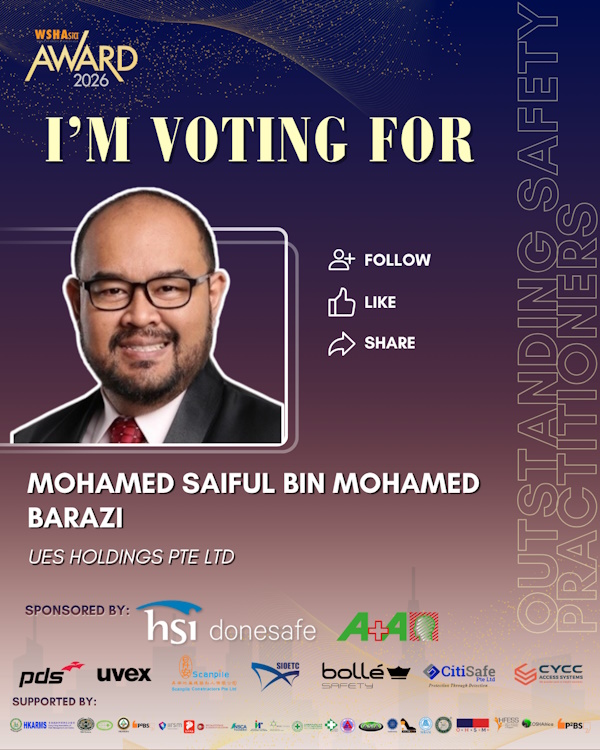
Name: Mohamed Saiful Bin Mohamed Barazi
Country: Singapore
Country: Singapore
About Mohamed Saiful Bin Mohamed Barazi
With over 25 years of expertise, Mohamed Saiful Bin Mohamed Barazi is a distinguished Safety professional specialising in the development and implementation of comprehensive QEHS management systems. He has served as a Group Safety Manager and Head HSE, guiding MNCs through complex safety integration and sustainable operations.
He excels in conducting high-impact risk assessments, workplace inspections, and fire safety training. A dedicated facilitator, he bridges technical engineering requirements with practical occupational health and safety solutions. His career is marked by numerous awards, reflecting a deep commitment to maintaining rigorous safety standards and fostering a proactive safety culture.
He excels in conducting high-impact risk assessments, workplace inspections, and fire safety training. A dedicated facilitator, he bridges technical engineering requirements with practical occupational health and safety solutions. His career is marked by numerous awards, reflecting a deep commitment to maintaining rigorous safety standards and fostering a proactive safety culture.
List the Safety and Health achievements/contributions you have achieved in 2025.
In 2025, Mohamed Saiful Bin Mohamed Barazi spearheaded the digital transformation of their Workplace Safety and Health (WSH) management system, resulting in a 20% reduction in reporting lead times and real-time risk mitigation. I successfully championed the ISO 45001 standards, achieving zero non-conformities during stringent external audits. To foster a proactive safety culture, he developed and facilitated targeted behaviour-based safety workshops for over 200 site personnel, a contributing key factor in our project reaching a significant milestone of 1.5 million safe man-hours without a Lost Time Incident (LTI).
Beyond basic compliance, he implemented a comprehensive Mental Health at Work initiative, training 20 supervisors as mental health first aiders to support holistic worker wellbeing on-site. His commitment to operational excellence was acknowledged by senior management for successfully integrating advanced fire safety protocols and enhanced risk assessment tools. These contributions have not only fortified their statutory compliance but have also established a sustainable, high-standard safety benchmark that protects the workforce while ensuring seamless project delivery and business continuity.
Beyond basic compliance, he implemented a comprehensive Mental Health at Work initiative, training 20 supervisors as mental health first aiders to support holistic worker wellbeing on-site. His commitment to operational excellence was acknowledged by senior management for successfully integrating advanced fire safety protocols and enhanced risk assessment tools. These contributions have not only fortified their statutory compliance but have also established a sustainable, high-standard safety benchmark that protects the workforce while ensuring seamless project delivery and business continuity.
Outline the Workplace Safety and Health initiatives that have been implemented by you in your workplace in 2025.
The site has implemented several key measures to enhance workplace safety and health. For safety during lifting operations, all crew members are now required to wear impact gloves, a rule that has been fully implemented site wide. To manage work coordination, Permit-to-Work (PTW) boards have been installed on different building levels, allowing other trades to identify incompatible activities and conduct a last-minute risk assessment if simultaneous work is unavoidable. To prevent fall-related incidents, all floor openings must be securely covered and barricaded with toe-boards, netting, and warning signs. Similarly, all lift shafts are protected with hard barricades, toe-boards, netting, and signage to prevent accidental or unauthorised entry.
For workplace health, a specific measure has been introduced for the Muslim workforce during the fasting period. They are required to have two strips of green tape applied to their safety helmets. This visual identification allows colleagues and supervisors to pay extra attention to them and more easily identify any tell-tale signs of abnormal behaviour related to fasting.
For workplace health, a specific measure has been introduced for the Muslim workforce during the fasting period. They are required to have two strips of green tape applied to their safety helmets. This visual identification allows colleagues and supervisors to pay extra attention to them and more easily identify any tell-tale signs of abnormal behaviour related to fasting.
Describe and support in detail on how your influencing capability has assisted in the successful implementation of these initiatives.
During the review period, Mohamed Saiful Bin Mohamed Barazi successfully transitioned several safety initiatives from conceptual stages to site-wide practices by leveraging a strategic, influence-based leadership style. By prioritising stakeholder engagement over top-down mandates, he fostered genuine consensus and operational buy-in across the workforce. For the implementation of impact gloves, he combined hand-injury data with peer-led testimonials to shift the requirement from a directive to an accepted safety standard. Similarly, he collaborated with trade leads to frame Permit to Work (PTW) boards and physical barricades as solutions for reducing schedule interruptions, which secured their active cooperation. He also led a sensitive health programme for fasting workers by consulting directly with the affected employees. This open dialogue framed the initiative as a supportive safety measure rather than surveillance, effectively building mutual trust.
Through these efforts, he aligned safety protocols with crew interests, cultivating a workplace culture where compliance is driven by shared values rather than simple enforcement.
Through these efforts, he aligned safety protocols with crew interests, cultivating a workplace culture where compliance is driven by shared values rather than simple enforcement.
Describe and provide support on how your initiative impacted the Safety and Health management and performance of your workplace/community/industry that was above and beyond.
The impact glove mandate, reinforced through peer-influenced acceptance, elevated personal protective equipment compliance beyond mere rule-following that dramatically reduced minor hand injuries. The PTW boards and comprehensive barricading systems revolutionised their coordination processes, eliminating the historically recurring issue of incompatible tandem works and achieving zero unauthorised entries into hazardous areas. This proactive visibility prevented potential fatalities from falls and dropped objects, representing performance exceeding standard industry practice.
Most significantly, the culturally sensitive green tape initiative for fasting Muslim workers established an unprecedented benchmark for occupational health. This simple visual identifier enabled supervisors to conduct discreet, dignified wellness checks, preventing heat stress and fatigue-related incidents among a vulnerable workforce segment. Together, these measures transcended typical safety performance indicators, fostering genuine trust between management and workers while embedding safety consciousness into daily operations.
Most significantly, the culturally sensitive green tape initiative for fasting Muslim workers established an unprecedented benchmark for occupational health. This simple visual identifier enabled supervisors to conduct discreet, dignified wellness checks, preventing heat stress and fatigue-related incidents among a vulnerable workforce segment. Together, these measures transcended typical safety performance indicators, fostering genuine trust between management and workers while embedding safety consciousness into daily operations.
In your opinion, what are the attributes of a safety influencer? Do share with us on how you have demonstrated these attributes in your daily work that will earn you the recognition of a WSHAsia Safety Influencer Award Winner in your workplace/community/industry.
In Mohamed Saiful Bin Mohamed Barazi's opinion, a true safety influencer embodies empathy, collaboration, and proactive visibility.
He demonstrated these attributes daily by first listening to the lifting crew's concerns about glove comfort before facilitating a peer-led toolbox talk, which transformed resistance into collective ownership. When implementing the PTW boards and barricades, he consulted trade leads individually, framing these measures as solutions to their scheduling conflicts rather than additional bureaucracy. Most significantly, for the culturally sensitive fasting worker initiative, he engaged directly with the Muslim workforce to frame the green tape as a support tool rather than surveillance. By fostering open dialogue and respecting their input, the measure was embraced as genuine care.
Through consistent visibility on-site, approachable conversations, and demonstrating that safety improvements stem from worker insights, he cultivated a culture where safety became a shared value. These attributes—empathy, collaboration, and trust-building—have earned recognition by embedding safety consciousness into everyday operations, not just compliance.
He demonstrated these attributes daily by first listening to the lifting crew's concerns about glove comfort before facilitating a peer-led toolbox talk, which transformed resistance into collective ownership. When implementing the PTW boards and barricades, he consulted trade leads individually, framing these measures as solutions to their scheduling conflicts rather than additional bureaucracy. Most significantly, for the culturally sensitive fasting worker initiative, he engaged directly with the Muslim workforce to frame the green tape as a support tool rather than surveillance. By fostering open dialogue and respecting their input, the measure was embraced as genuine care.
Through consistent visibility on-site, approachable conversations, and demonstrating that safety improvements stem from worker insights, he cultivated a culture where safety became a shared value. These attributes—empathy, collaboration, and trust-building—have earned recognition by embedding safety consciousness into everyday operations, not just compliance.
No. of Years of Experience in a Safety Role:
20 Years