Back to Name List
Now you are viewing:
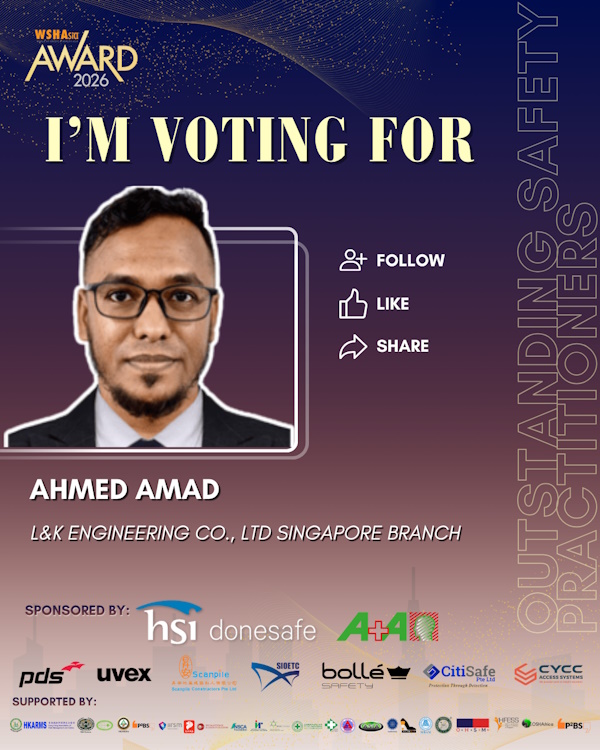
Name: Ahmed Amad
Country: Singapore
Country: Singapore
About Ahmed Amad
Ahmed is a dedicated Safety Professional with extensive experience in workplace safety, health, and environmental management within the construction industry. He is passionate about promoting a strong safety culture, ensuring compliance with regulations, and implementing proactive risk management strategies. With hands-on experience in site safety supervision, contractor coordination, and incident prevention, Ahmed consistently strives to create safer and healthier work environments.
List the Safety and Health achievements/contributions you have achieved in 2025.
In 2025, he actively contributed to strengthening workplace safety and health standards across multiple project sites. Key achievements include: successfully maintained a Zero Lost Time Injury (LTI) record across assigned work areas through strict supervision and proactive risk control measures; led and coordinated several safety campaigns focused on Work at Height, Lifting Operations, and Fire Prevention, significantly improving worker awareness and compliance; conducted regular site inspections, hazard identification exercises, and risk assessments, ensuring timely corrective actions and reducing unsafe practices; implemented improved Permit-to-Work (PTW) monitoring systems to enhance control over high-risk activities; organised toolbox meetings and safety training sessions to reinforce safe work procedures among contractors and workers; recognised for promoting strong safety culture and collaboration between main contractors and subcontractors; actively supported management during internal and external audits, ensuring compliance with regulatory and company safety standards.
Outline the Workplace Safety and Health initiatives that have been implemented by you in your workplace in 2025.
In 2025, he introduced and strengthened several Workplace Safety and Health (WSH) initiatives to enhance risk control, worker awareness, and overall site safety performance:
Enhanced Work-at-Height Control Program: Implemented stricter scaffold inspection checklists, ladder control measures, and mandatory harness inspection logs to minimise fall-from-height risks.
Improved Permit-to-Work (PTW) System: Strengthened monitoring and verification procedures for high-risk activities such as lifting operations, hot work, confined space entry, and excavation works.
Monthly Safety Campaigns: Organised targeted campaigns focusing on key risk areas including fire prevention, electrical safety, housekeeping, and safe lifting practices.
Behavior-Based Safety (BBS) Observations: Introduced routine safety observation and intervention practices to correct unsafe behaviors immediately and promote positive safety attitudes.
Toolbox Talk Enhancement: Standardised daily toolbox briefings with documented attendance and hazard-specific discussions aligned with ongoing site activities.
Enhanced Work-at-Height Control Program: Implemented stricter scaffold inspection checklists, ladder control measures, and mandatory harness inspection logs to minimise fall-from-height risks.
Improved Permit-to-Work (PTW) System: Strengthened monitoring and verification procedures for high-risk activities such as lifting operations, hot work, confined space entry, and excavation works.
Monthly Safety Campaigns: Organised targeted campaigns focusing on key risk areas including fire prevention, electrical safety, housekeeping, and safe lifting practices.
Behavior-Based Safety (BBS) Observations: Introduced routine safety observation and intervention practices to correct unsafe behaviors immediately and promote positive safety attitudes.
Toolbox Talk Enhancement: Standardised daily toolbox briefings with documented attendance and hazard-specific discussions aligned with ongoing site activities.
Describe and support in detail on how your influencing capability has assisted in the successful implementation of these initiatives.
The successful implementation of the 2025 Workplace Safety and Health initiatives was largely driven by his ability to positively influence workers, supervisors, and management at all levels.
Firstly, he focused on building trust and credibility on site by being consistently present, approachable, and solution-oriented. Instead of enforcing safety purely through authority, he engaged workers through open conversations, explaining the why behind each safety requirement. This approach helped shift mindsets from compliance-based behaviour to personal responsibility for safety.
During the implementation of the enhanced Work-at-Height and PTW control measures, he worked closely with supervisors and subcontractor leaders to gain their buy-in before rolling out changes. By involving them in discussions and risk assessments, they felt ownership of the process, which significantly improved cooperation and adherence.
Firstly, he focused on building trust and credibility on site by being consistently present, approachable, and solution-oriented. Instead of enforcing safety purely through authority, he engaged workers through open conversations, explaining the why behind each safety requirement. This approach helped shift mindsets from compliance-based behaviour to personal responsibility for safety.
During the implementation of the enhanced Work-at-Height and PTW control measures, he worked closely with supervisors and subcontractor leaders to gain their buy-in before rolling out changes. By involving them in discussions and risk assessments, they felt ownership of the process, which significantly improved cooperation and adherence.
Describe and provide support on how your initiative impacted the Safety and Health management and performance of your workplace/community/industry that was above and beyond.
In 2025, his safety initiatives went beyond routine compliance and significantly strengthened the overall Safety and Health management system within the workplace.
One major impact was the transformation from a reactive safety approach to a proactive, prevention-driven culture. Through the introduction of enhanced Permit-to-Work controls, Behavior-Based Safety observations, and an active Near-Miss Reporting Drive, hazards were identified and rectified before incidents could occur. This led to measurable improvements in site compliance standards, housekeeping, and high-risk activity control.
The strengthened Work-at-Height and lifting operation controls reduced unsafe acts and improved supervision accountability. Supervisors became more engaged in daily risk assessments, which enhanced ownership of safety at the operational level rather than relying solely on the safety department.
His initiatives also improved communication between management and workers. By encouraging open reporting and recognising positive safety behaviour, workers became more confident in raising concerns without fear.
One major impact was the transformation from a reactive safety approach to a proactive, prevention-driven culture. Through the introduction of enhanced Permit-to-Work controls, Behavior-Based Safety observations, and an active Near-Miss Reporting Drive, hazards were identified and rectified before incidents could occur. This led to measurable improvements in site compliance standards, housekeeping, and high-risk activity control.
The strengthened Work-at-Height and lifting operation controls reduced unsafe acts and improved supervision accountability. Supervisors became more engaged in daily risk assessments, which enhanced ownership of safety at the operational level rather than relying solely on the safety department.
His initiatives also improved communication between management and workers. By encouraging open reporting and recognising positive safety behaviour, workers became more confident in raising concerns without fear.
In your opinion, what are the attributes of a safety influencer? Do share with us on how you have demonstrated these attributes in your daily work that will earn you the recognition of a WSHAsia Safety Influencer Award Winner in your workplace/community/industry.
A true safety influencer is not defined by position or authority, but by impact. The key attributes include integrity, strong communication skills, consistency, technical competence, empathy, courage to act, and the ability to inspire behavioural change.
Firstly, integrity and leading by example are fundamental. He consistently complies with all safety rules, wears proper PPE, and follows procedures strictly. By demonstrating the standards he expects from others, he builds credibility and trust among workers and supervisors.
Secondly, effective communication is critical. He engages workers in a language and tone they understand, explaining not only what must be done, but why it matters. During toolbox meetings and site walkabouts, he encourages open discussions rather than one-way instructions. This approach has improved worker participation and ownership of safety practices.
Firstly, integrity and leading by example are fundamental. He consistently complies with all safety rules, wears proper PPE, and follows procedures strictly. By demonstrating the standards he expects from others, he builds credibility and trust among workers and supervisors.
Secondly, effective communication is critical. He engages workers in a language and tone they understand, explaining not only what must be done, but why it matters. During toolbox meetings and site walkabouts, he encourages open discussions rather than one-way instructions. This approach has improved worker participation and ownership of safety practices.
No. of Years of Experience in a Safety Role:
13 Years